 searchingtosee
Nephology
Posted on May 10, 2012
Recently, I’ve been doing a lot of cloud gazing. We’ve had plenty of moody skies which makes for interesting and dramatic cloud formations. I haven’t felt much like photographing them, though, strangely.
I just want to look.
The master of all cloud photographers was, I think, Alfred Stieglitz. He made his series of Equivalents as a response to a critic who believed that he had some kind of hypnotic power over his subjects, and claimed therein lay his photographic talents. Affronted, he set about to prove unequivocally that he could take good pictures of other things. Things which couldn’t be hypnotised by his lens. He turned his camera upwards and looked to the sky, to the clouds.
 Alfred Stieglitz – Equivalent
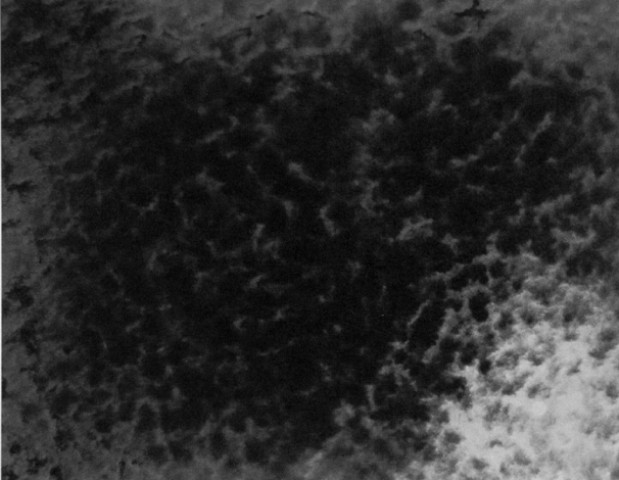
Alfred Stieglitz – Equivalent

Alfred Stieglitz – Equivalent

Alfred Stieglitz – Equivalent

Alfred Stieglitz – Equivalent
His mother was dying at the time, and these beautiful images are also a moving and emotional tribute to her. Abstract art has such power to both convey and reflect human emotion, holding up a mirror to our souls.
Was he searching for the truth? An escape from reality? Or blessed relief from the pain of losing a loved one? Was he looking for God?
We will never know exactly, but of course part of their appeal and potency is their universality. We can all find our own solace – our own answers – in them.
Clouds induce in me a lazy state of daydreaming – one of my most favourite past-times. My children enjoy that age-old past-time of spotting recognisable forms (animals, flowers, trees) in the clouds, and mostly when I think about clouds I think about childhood, although I’m not sure why. Maybe it’s because my children are so fascinated by them, or maybe because I was as a child.
And children are fascinated by clouds aren’t they? Usually I think of them as quite friendly and fluffy. Though sometimes they can be scary and menacing like the Cloud Men in Roald Dahl’s James and the Giant Peach.
The other day, walking my son home from school in the rain (again) he commented on a discussion he had had with some friends at school about the rain. He said he thought that when it was raining it was God having a shower, but another friend thought that it was God’s tears. “Mummy”, he sighed, “either God is having a lot of showers lately, or he is very sad.”
I wrote these two poems about cloud-gazing from a child’s perspective (and please forgive me if they are very bad I know I am not a poet but I am trying out some new things, and perhaps they are not quite done I’m not sure yet):
Nephology
Evapotranspiration. Troposphere. Stratosphere. Mesosphere. Cumuliform. Cirrocumulus.
I say the unfamiliar words out loud
Try them
Roll them around thoughtfully, clumsily in my mouth
A sugary boiled sweet clattering against my teeth
Nacreous: very high clouds. Exhibit lustrous, rainbow colours like mother of pearl
Noctilucent: night clouds. The highest clouds in the atmosphere. Illuminate during deep twilight
A new pair of too-tight leather shoes
Not easy
Not comfy
Nephology: the study of clouds
An other language
Beautiful, strange
Not mine fluently tripping off my tongue
With a skip and a hopscotch: 1… 2-3… 4… 5-6…. 7… 8-9… pick up the stone – and back again.
Can I say it backwards?
Ygolohpen (eeee-jolo-pen)
I’m stuck
Standing still
I suck
The sweet deposits itself in the hollow of my left cheek
Oozes gently filling my mouth with a burst of sickly syrupy lusciousness
I look up
Smile to myself
After a while, I turn around and hopscotch back
My once shiny shoes now scuffed and worn
Moulded to my feet
Things that once were new become part of me
Cloud kisses
I watch the clouds up in the sky
Feel the sunshine on my face
Wonder: can they see them up in space?
I watch the clouds up in the sky
White-whipped marshmallow kisses
Heaped moody-grey wishes
I watch the clouds up in the sky
I watch the thin vapours drift, I watch them roam
Restless puffs of foam
I watch the clouds up in the sky
Sheet-like fold me up a letter
Swaddle me a soft dove-grey angora sweater
I watch the clouds up in the sky
Send me surfing on a halo-hazed rim
I follow them to nowhere on a whim
I watch the clouds up in the sky
I skip a rainbow trip
Reach out to grip
Does God take his strong ancient hands
And wring each raindrop from the clouds
Until they are spent?
I watch them fall
Feel them splash upon my nose, my eyelashes
I stick out my tongue to taste
The tang of His salty-sweet tears
© Emily Hughes and searchingtosee, 2012
For reference, these are the websites I took the images from:
http://theindecisivemoment.wordpress.com/2010/11/17/inspired-by-a-master-alfred-stieglitz/
http://phomul.canalblog.com/archives/stieglitz__alfred/index.html
http://www.moma.org/collection/object.php?object_id=44200
The space in-between: Reflections of a passenger
Posted on May 7, 2012
Continuing on a theme, which I first blogged about here on photographing the spaces in-between; I thought I would share with you some pictures from a project I did for my MA. I am copying and pasting the pictures, and the introduction to the book as I wrote it (almost 7 years ago now!), although there is probably much I would change now.
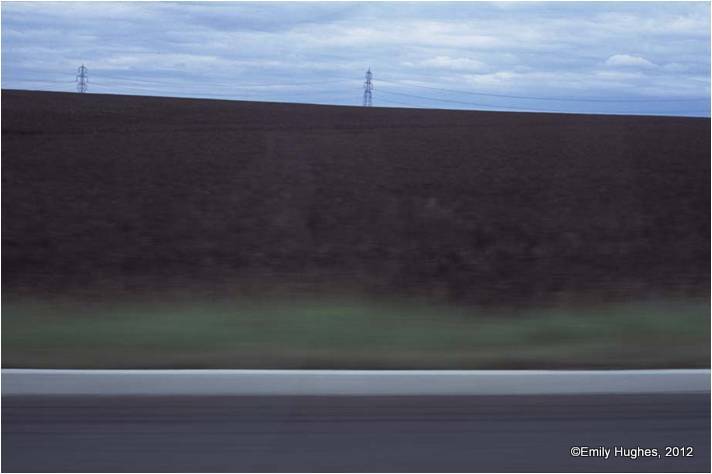
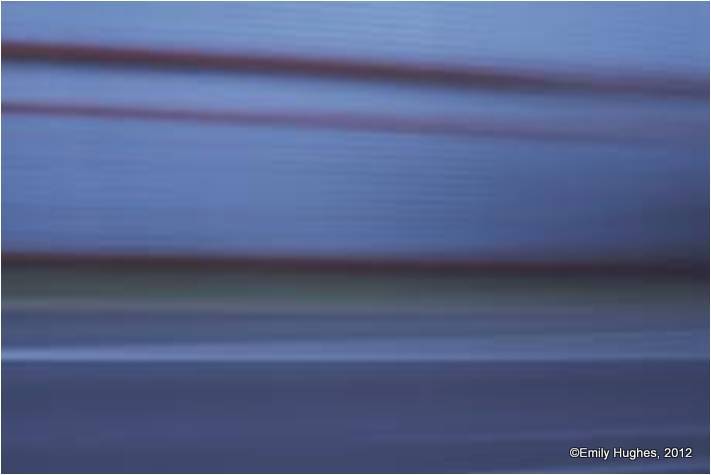
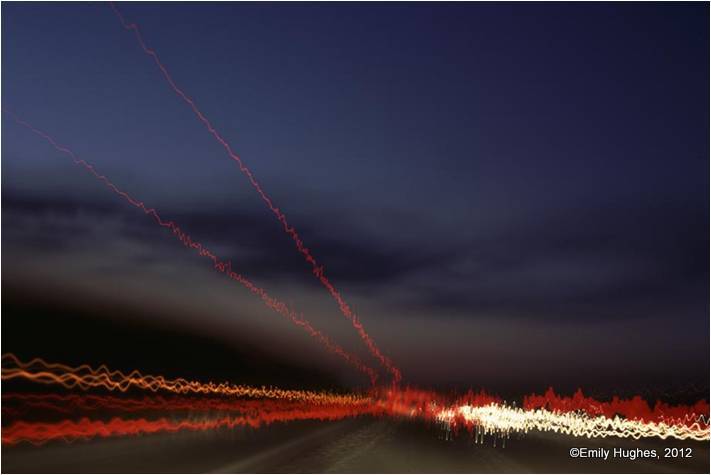
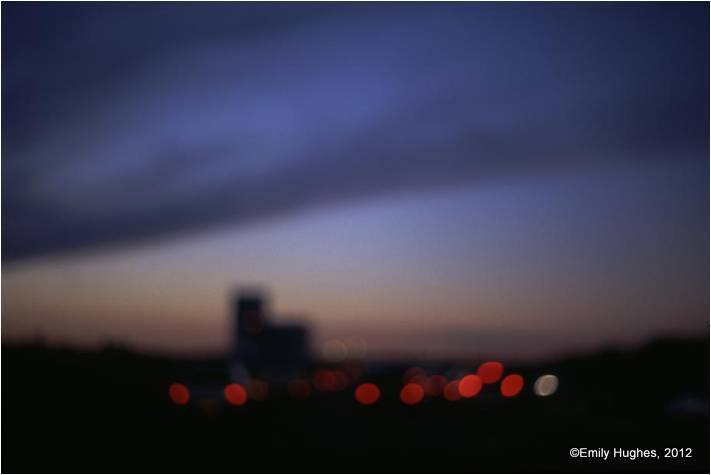
These images are all taken on car journeys, through the windscreen or passenger window, whilst travelling on various motorways up and down the UK. They are very low quality I’m afraid as I can’t find the original disc (they were scanned from transparency film) so I took them from the book proof pdf.
The intimate is not a space but a relationship between spaces.
Beatriz Colomina
The space in-between is a space between here and there, between dreams and waking.
It is invisible; a kind of nowhere, somewhere, anywhere… a place which harbours our daydreams.
Through these narrow chinks new possibilities emerge to dazzle the eye like sunlight glimpsing through a cracked wall, and we can dream a different story, or imagine another journey which our fate does not follow for a fleeting, precious instant.
These intimate, indulgent moments in which we (if only temporarily) dwell, offer us shelter, escape, hope, despair, contentment and yearning.
These images chart a period of being a passenger; of frequent journeys I have made, places I have been transported to and daydreams I have had along-the-way.
As the window frame fills with transient scenes I freeze them in an instant, drink them up greedily, and then erase them with one click of the camera shutter. Now they are mine.
Blurred by my eye, they become something other, these non-landscapes of my journeys; not here, not there, not quite anywhere. But they are stored forever in my dreams.





The quote is from Privacy and Publicity: Modern Architecture as Mass Media by Beatriz Colomina
© Emily Hughes and searchingtosee, 2012
Colouring outside the lines
Posted on April 22, 2012
So, I’ve been blogging for two weeks now, and after my initial posting frenzy I have decided that I really cannot manage to post every day. The housework is starting to suffer, I can’t find anything, the washing pile is taking on a life of its own, and the children are, well, just hanging off me, literally, at any given opportunity. I get the message: they are starved of attention. I’m feeling bad, and things need to settle down now into a gentle, manageable rhythm – more moderato than presto, let’s say. With that in mind I have decided to limit my posting to three times a week (hopefully quality, not quantity, in the spirit of Friday’s post – see below), and I’m going to aim to do two shorter posts and one longer one each week (but, of course, I reserve the right to completely change my mind about all of that at any point in time).
Anyway, let’s get back to the point of this post which is not really about photography or phenomenology (directly, at least). The title is inspired by this lovely poem Colour Outside the Lines, by Jared Louche:
I was always told to colour inside the lines,
but sometimes lines just confine your mind.
From somewhere far down in the orange deep
I start to see new colours flowering all around me.
Confusion looks like black static-scrapes
on crinkled, white, burned-edge paper scraps.
Sleep’s always coloured deep-ocean green,
rivers of copper tug me through lavender dreams.
Bubblegumblebees swirl from my head
When I’m being silly in bed;
electric red-yellow wasps start to drone
when I’m an angry screaming cyclone.
Thinking hard at doing maths, my head follows
pencil-thin, jagged, rust-red paths.
Shouts are nasty, silver daggers stabbing
Huge policeman’s blue hands grabbing.
Whispers slip out on a crisp, cream strip
with chocolate-brown writing typed across it.
Snores have wide, blazing tiger bands.
Boredom has no colour but fog-grey on wet sand.
Birds chirp chatty, blue paint chips.
Dog barks are cloud-white with dawn-golden sparks.
Trucks rolling by burp grouchy black splashes.
Bicycle bells ring in shaky pink flashes.
Thunder blows a splatter of sickness-green grim,
brushed throughout in a bruised-blue trim.
Boiling kettles make tiny neon-yellow fish that swim.
When I sing a song,
a long string of loud,
rowdy colour explosions
slowly go floating
past my nose and
hilarious horns brightly
pop purple spikes.
Drums’ black splashes and
guitars roar orange-red slashes clash,
blue fuzzy bass feathers fly by and
white flecks of dry piano bone-specks
spatter across the mixing mess.
Glorious, glorious, colourful mess,
But music’s the colour I love the best.
It’s a wonderful, vibrant, symphony of colour. When I read it I think of a child allowed to run wild and just create: sing, paint, make music, dance in all the glorious clashing colours of the rainbow. And don’t we, when our children are little, encourage them to run wild with bright colours, to just be creative without restriction or adhering to form? But then, as they grow up and go to school, something happens and we start expecting them to conform. We start expecting them to be neat; to colour between the lines.

When my son was three he went to pre-school. We were living in Italy at the time. I remember one day his nursery teacher pulled me aside and expressed mild concern at the fact that he struggled to keep his colouring between the lines. She was so kind and looked so earnest about it and I remember nodding my head and trying also to look concerned, but inside I was wondering why on earth this was so important, that my son who was only 3, and just wanted to run around and be wild, should be able to pick up a crayon and colour in a picture without going over the lines. I shrugged my shoulders and assumed that it was some kind of cultural thing and decided not to worry about it. Now that he is 6 and I know much more about the education system, I understand completely why that teacher expressed concern. Of course, colouring is a pre-cursor to writing and we encourage nice neat colouring in schools and nurseries so that children will develop their vital fine motor schools that will allow them to in turn develop nice neat handwriting later on.
Except of course there are some children, like my son, who have no desire to conform, and no interest in learning to colour between the lines. For them, school is a long, hard battle of wills.
Last night, Alex and I had a rare night out in London to have dinner with some old university friends. The red wine was flowing, and as we picked at our tapas we got to chatting about all the extracurricular stuff we were up to. One of us plays lead guitar in a band and does gigs, the other is taking acting classes but has dabbled in singing too, and another is getting involved in her local community, doing a course in permaculture, volunteering in her local amateur theatre group, teaching youth theatre workshops and writing screenplays (she’s a busy girl). Alex is also very much into doing photography, but also painting, and his music (we have about eight guitars in the house, all of which he plays – we joke that they are breeding). And of course I am doing my blog and photography. This is all in our spare time, on top of holding down full-time jobs. (That is apart from me as I work part-time, but I like to think the children and the housework more than make up for the other 60% of my workload.)
We wondered why it was, that at this point in our lives, in our mid 30s, we have started to feel the need to reignite our latent creative urges, which have probably for most of us pretty much lain dormant since at least our free and easy university days if not since early childhood. None of us really do particularly creative jobs for a living, but we all felt the need for some kind of outlet in our spare time (or indeed, perhaps because of this). And we all felt like we had mostly suppressed our creative sides for so long for fear of not being taken seriously, or not being very good, or lack of confidence, or lack of time, or a combination of all of the above. It is quite scary to veer off in another direction and do something new. It takes more than a bit of courage.
It’s almost as though a fresh surge of creativity has welled up from deep inside us at the same time. Yet this time, there is an urgency about it. The lazy arrogance of youth has dissipated and its place there is determination and necessity. There is a sense that this is our last chance to get it all out while we are all still young-ish, and able and full of energy-ish. But it runs deeper than that, too. Many of us at a certain point in our lives realise that maybe we might want to try walking that alternative path that we could have taken, but didn’t for whatever reason. Maybe, like me, your parents or your teachers discouraged you from following more creative subjects at school because they weren’t ‘academic’ enough and were unlikely to secure you a place at a ‘good’ university or give you those elusive ‘opportunites’ to forge a decent, respectable career.
I loved art at school. It was my favourite subject along with English, but I never took art A-level because it was just never really valued as a subject. And people (even teachers) would say, well what are you going to do with art? How crazy is that, really? And how crazy is it that vulnerable, immature 16 year olds who know nothing of the world are forced into making life-limiting decisions like that which will ultimately fashion the path they will take in life. These are the first steps we take in narrowing our choices in life rather than broadening them, and narrowing our minds.
Education is the key factor here, of course. The other day I came across a talk on TED by Sir Ken Robinson (I love TED talks – I have the app on my iPhone and watch them whenever I can snatch twenty minutes here or there) on the subject of how schools kill creativity in our children. His premise is that the global education system stifles creativity in our children in order to prepare them for an ‘ideal’ life of academia. But of course in reality this is not the kind of route that all children would desire to take, or indeed should. Why do we pressurise our children into aiming for a university education, why do we prize that above all else, when a university education doesn’t really get you a job anymore?
We are failing our children because we are not preparing them for an uncertain future, where creativity and the ability to innovate will be the most valued skills we can offer to the job market. For me it is also simply about teaching our children to be true to themselves. This is the key to creating happy, well-rounded, succesful individuals. The speech is fascinating, inspiring, sad and hilarious (I defy you not to laugh out loud at the anecdote about the girl drawing a picture of God). I highly recommend checking it out.
So I will try, (tenuously?) to bring this back to photography. I have actually been thinking about these points a lot with reference to the subject. The photograph I have included today is a picture of one of my son’s drawings. He likes to fill the page to bursting with lots of colour and lots of intricate detail. He often adds bits of torn paper with writing. It’s almost as though he cannot be contained by a piece of A4. There is everything original about this picture – my son conceived it, and coloured it himself, but there is nothing original about the photograph. It is a picture I have stolen from ‘real life’. This is something which I both enjoy and find frustrating about a photograph at the same time: it can’t exist in its own right, and (unlike other art forms) it has to be contained by its own form. I don’t wish to enter into a debate about whether photography can be art (I think unquestionably it can be), but I do question whether it can ever be truly original. You can’t colour outside the lines of a photograph… can you?
And if you can or could, what would that kind of photography look like?
© Emily Hughes and searchingtosee, 2012



 searchingtosee